Sabtu, 02 April 2011

Position of Back Junction

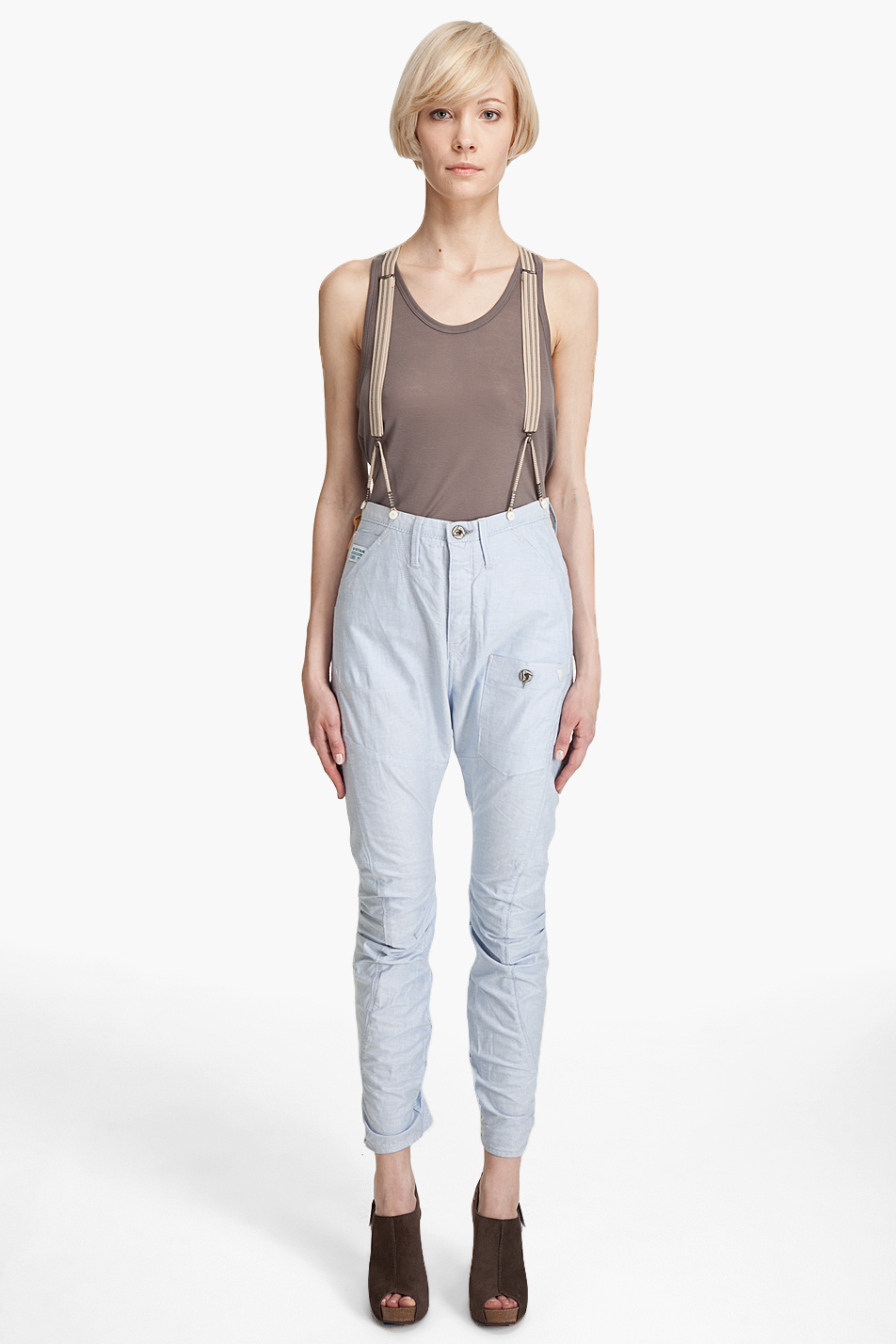
Nowadays braces (and suspenders) cross over in the back. Originally, braces were simply straps of material that were made of leather attached to pants, similar to this...
These straps will slip off
the shoulders
Case in point - the strap slip off
the shoulder
Because of the normal body movement, the straps were prone to slip off the shoulders and not serve their purpose. Therefore, to rectify this problem the straps were crossed over in the back. Additionally, the invention of elastic and application to suspenders greatly improved the flexibility of braces to remain on the shoulders.

The straps on X-back braces and Y-back braces come together in a junction. The position of this junction relative to the wearer is important for comfort and style. If the junction is too low, the straps will be more prone to slip off the shoulders and will be uncomfortable on the shoulder blades.


If the junction is too high, the straps will be nestled around your neck and feel uncomfortable, as illustrated below.

Not all junctions are movable (see above). In these cases, you will have to live with the style, or get new suspenders. However, if the junction is adjustable, you can move it to the correct location, as described above.


Take note of this vintage photo of 2 men strolling down the street, wearing high-waisted pants, reminiscent of the zoot suit era in the early 20th century:


Here's a close-up with emphasis added to show the 2 different styles and the detail of the back junction. The man on the left is wearing X-back braces with the junction rather high and the rear buttons spread apart, towards the sides. The man on the right is wearing Y-back braces with the junction very close to the neck, and the rear buttons closer to the middle seam.


This is photo displays 2 different styles and different position of the back junction.


Where should the junction be located? 
So where should the junction go? The junction should be located just below the shoulder-blades, to allow the straps to run over the shoulders and above the shoulder blades. This results in the junction being just above the centre of the back and provides the greatest comfort. Here are photos illustrating correct position of the junction:
Notice that the junction is mid-back – so the straps cross above and around the shoulder blades.


Discussion time:
  • Where do you position your back junction?
  • Where do you find it most comfortable?
Note: all photos are used solely for non-commercial use and to illustrate braces in fashion. No plagiarism is intended.

    Kamis, 25 November 2010

    Braces width

    The width of braces is a key factor in wearing braces. They can be for functional purposes (generally a larger width), or for style (generally a narrower width). However, the width should be proportional to your body size. For example, the braces below are too wide for this overall outfit and do not fit her frame proportionately. Narrower suspenders should have been used. (Not to mention that the shorts should use button on braces instead of clip-on suspenders).


    You can sometimes push the edge of the wide verses thin, depending on the rest of the outfit. Take the following example below. As the bowtie is exaggerated and the pants are super high waisted, the larger suspender straps fit the body.
    Appropriate proportions

    The width is proportional to the shorts

    With that in mind, the width also varies based on the type of the outfit. For instance, for business suits, the straps are generally 1 or 1.25 inches, as shown below. However, given the smaller size of this gentlemen, the straps appear out of proportion - he would be better suited for thinner straps.
    Braces for suits are generally wider

    For modern wear in 2010, the width is narrow – generally 0.5 inches. Both are acceptable and depend on the overall look you are trying to achieve.


    Some people may feel that smaller width braces bind when wearing them, while wider ones feel unnatural and uncomfortable. So make sure you try out different widths and see what feels best for you.

    Discussion time:
    • What width of braces do you wear?
    • Do you find larger width braces uncomfortable?
    Note: all photos are used solely for non-commercial use and to illustrate braces in fashion. No plagiarism is intended.

      Sabtu, 16 Oktober 2010

      Adaptations of Braces

      Braces were originally designed to hold up pants. As Alan Fusser states, “Trousers were originally made to be worn with suspenders, which held them on the waist, not the hips, and that is where they look and hang best.”

      Braces were then attached to skirts, as they also need support.


      In recent years, braces have also been added to other articles of clothing such as vests and skirts.


      Or adaptations on the braces themselves. Such as 

      • Wing-tips on the braces


        • Fur braces

        Regardless of where braces are used, more people should start wearing them!


        Discussion time:
        • Do you wear braces on other items of clothing, besides pants and skirts?
        Note: all photos are used solely for non-commercial use and to illustrate braces in fashion. No plagiarism is intended.

        Rabu, 13 Oktober 2010

        Stories about Braces

        Everyone has them: stories about braces. It could be their first experience, the first time a button popped off, or people’s comments when they see you wearing braces. I’m interested in hearing your stories.

        To get you thinking, here's two stories from newspapers:
        Swank Injured By Suspenders In Freak Set Accident
        06 January 2007

        Actress HILARY SWANK needed stitches while shooting new movie P.S., I LOVE YOU when she was hit by a co-star's suspenders. The Oscar winner was acting opposite movie husband GERARD BUTLER in the film when his braces snapped and hit Swank in the forehead. She says, "It came undone and flung across the room and hit me in the forehead... I had stitches. "Blood is trickling down my head and it left a perfect suspender mark - you know, the jagged edge of a suspender and then the straight edge."

        This would have never happened if Gerard was wearing button-on braces. Be ware of clip-on suspenders!

        Suspenders save Life
        From November 9, 1918

        His heavy suspenders saved Horace Gibbs, of No. 1125 Clover street, from being killed in Camden by Emanuel McKimm of No 742 Sycamore street. When McKimm was arraigned before Recorder Stackhouse yesterday on a charge of firing teh shot, Gibbs showed where the bullet plowed through his vest and shirt and then was stopped by steel in the suspenders.
        It was explained that when Gibbs was taken to the Cooper hospital the bullet fell to the floor as the physicians were about to probe for it. The accused man was committed to jail in default of $1,000 bail. The two had quarred about a trivial matter.

        Wear suspenders - it may save your life!


        You may also want to check out this story.

        Start wearing braces, no matter what your friends say!


        Discussion time:
        • Share your stories!
        • Any memories from your first time?
        • Any humorous stories?
        • Any stories of the first time a button popped off, or a suspender snapped off?
        Note: all photos are used solely for non-commercial use and to illustrate braces in fashion. No plagiarism is intended.

        Sabtu, 09 Oktober 2010

        Vests and Braces

        Winston Churchill in classic attire for his day
        There’s a direct connection between wearing braces and a vest. Alan Fusser (“Dressing the Man” 2002) describes it further: “The vest as we know it today originated with the postboy waistcoat of nineteenth-century England. It was worn for warmth by the postboy, or postillion, who rode as guide on the horse attached closest to the coach.

        “Up until World War II, men always wore vests in the wintertime with their single-breasted suits. In recent years the vagaries of fashion have brought this custom in and out of favor. “Fashion” should not be your guide. If you have an opportunity to purchase a vest with you suit, do so. There are numerous advantages to owning a vest, not the least of which is the increased versatility of a three-piece suit. A suit worn with a vest always gives a slightly dressier look.


        The vest gives a clean, smooth look
        Vests should fit cleanly around the body, covering the waistband of the trousers and peeking just above the waist button (or middle button) of the suit jacket. Good vests are often cut so that one doesn't button the bottom button, a tradition that began when a member of English royalty appeared at a public function with his bottom button mistakenly undone. This faux pas was picked up by the middle class and has remained with us ever since, producing a casual, somewhat more open look.


        “Of course, there's no sense wearing a vest if it's not worn correctly. When the jacket is buttoned at the waist, one should be able to see just a small part of the vest above it. Any higher than this and the effect becomes strained, concealing too much of the tie as well. Also, the neckline of the vest should not cover the collar points of the dress shirt but should instead clip them slightly. In addition, the entire elegance of a three- piece suit is destroyed if the trousers are worn on the hips, below the inverted V at the bottom of the vest. This allows the shirt or belt to interrupt the smooth transition line from vest to trousers.

        “A well-made vest has a definite waistline, which is where the waistline of the trousers should hit. The front of the proper vest is normally made from the same fabric as the suit, while the back uses the same fabric as the sleeve lining of the suit jacket.
        The correct way to wear a vest
        After removing the vest, it's visible to see the pants are supported by braces
        “Vests are adjustable in the rear and traditionally have four slightly slanted welt pockets - two just below the waist and two breast pockets. The breast pockets are deep enough to hold a pair of glasses or a pen, while the shallow lower pockets afford one the option of sporting a pocket watch.

        The pants pass over the waist
        “In the last twenty years, the popularity of jeans and European-style pants has unfortunately accustomed most young men to wearing trousers that are too tight and rest on their hips. Trousers were originally made to be worn with suspenders, which held them on the waist, not the hips, and that is where they look and hang best. No well-dressed man would wear trousers that rested anywhere else. This is not an arbitrary gesture. Every man, no matter how thin, has a slight bulge in his stomach area. When trousers are worn on the waist, they pass smoothly over this bulge in an even drape. Furthermore, waist-worn trousers emphasize the smallness of the waist. They sit there comfortable, supported by the hips. Trousers worn on the hip, however, must be belted tightly, for there is nothing to hold them up. In consort with a vested suit, trousers resting on the hip can only detract from the overall appearance, particularly when there is a gap between vest and trouser top. There is nothing more unsightly - and nothing that draws more attention to the waist - than to have a visible bunching of the shirt or the belt sticking out from between the vest and trousers. The solution is to reaccustom yourself to the way men used to wear trousers. It made sense then and it still does today.

        As illustrated below, compare the difference in these two photos. The outfit on the left shows a large, white gap above the waist-line and draws attention to the mid-section. The outfit on the right has a clean, smooth line that passes over the mid-section. If you look closely you will notice that the one on the right also has braces attached.
        As you can see, braces are required when wearing a vest, to keep the shirt from sticking out between the pants and vest, or having a bulge from the belt buckle.

        Discussion time:
        • Do you wear vests?
        • Do you wear braces with vests?
        Note: all photos are used solely for non-commercial use and to illustrate braces in fashion. No plagiarism is intended.

          Rabu, 06 Oktober 2010

          Snapping Your Braces

          Ever since elastic was used as a materials for braces, people have been snapping the brace straps. Be it by yourself or by others, this is a fun fashion accessory to play with.

          Elastic braces provide the flexibility to support your pants, but also give someone an easy opportunity to inflict some pain.

          People snapping your braces shouldn’t deter you from wearing them though. It’s part of the territory of wearing braces. If one of the buttons pops off and hits them in the eye, you can say they deserved it.

          One could wear non-stretch brace, such as braid, leather, or cloth, but these then perform poorly when the individual bends down or stretches.

          Brace straps are frequently used for hanging on - for example, in piggy back rides.

          Or similarly, this man’s braces are likely being used to anchor his sons' ride. Hope those buttons don’t pop-off!

          Some people snap their own braces. This can be fun, until it snaps back!

          So go ahead snap your braces. And if someone else does it for you, treat it as a pat on the back!

          Maybe you just like to hook your thumbs behind your braces. This is very comfortable!


          Or even your whole arm!

          One things for sure, they make for a good hand-hold for kissing.


          Discussion time:
          • Do people snap your braces?
          • What do you do when someone snaps your braces, especially from the back?
          • Do you like to hook your thumbs behind your braces? 
          Note: all photos are used solely for non-commercial use and to illustrate braces in fashion. No plagiarism is intended.